
AI-Powered Transport Data Extraction
How we automated the import of 50+ document formats across multiple languages, reducing manual processing time by 92% for a Slovenian logistics company.
The Client
Avtotransport Makše
Avtotransport Makše is a Slovenian vehicle transport and logistics company specializing in the transportation of cars across Europe. They work with a wide network of manufacturers, dealers, and logistics partners, handling vehicle pickups and deliveries across multiple countries.
As a mid-sized logistics operator, they process a high volume of transport orders daily from dozens of different companies, each using their own document format and language. The diversity of their partner network is a strength for their business but created a significant operational bottleneck in document processing.
The Challenge
Every day, Avtotransport Makše received between 20 and 50 transport order requests via email. Each order contained critical logistics information: pickup locations, delivery destinations, vehicle details (make, model, VIN), scheduled dates, and sender/receiver information.
The problem was threefold:
Format Chaos
Over 50 different document formats from different companies. PDFs, email bodies, structured tables, free-form text — no two companies sent orders the same way.
Language Barrier
Documents arrived in German, Italian, Slovenian, English, Croatian, and other European languages, each with their own conventions for addresses and dates.
Sequential Bottleneck
A staff member had to open each email, read the document, manually identify and copy each field into their system. At ~1 minute per document, the work was sequential and blocked other tasks.
The Solution
We built an AI-powered agentic platform that fully automates the extraction of structured logistics data from incoming transport orders. The system hosts a dedicated email address to which the client forwards (or auto-forwards) all incoming transport requests. From there, everything is automatic.
How It Works
Receive
Transport order emails with PDF attachments are automatically forwarded to a dedicated inbox. The system ingests them via webhook and matches the sender's domain to a known company profile.
Parse
Documents are parsed using OCR and text extraction to handle any format — scanned PDFs, digital PDFs, embedded email tables, or plain text. Multiple languages are supported natively.
Extract
An AI model extracts 10+ structured fields from each document using few-shot learned patterns specific to each company's format. Fields include pickup/delivery locations, vehicle details (make, model, VIN), dates, and sender/receiver information.
Validate & Export
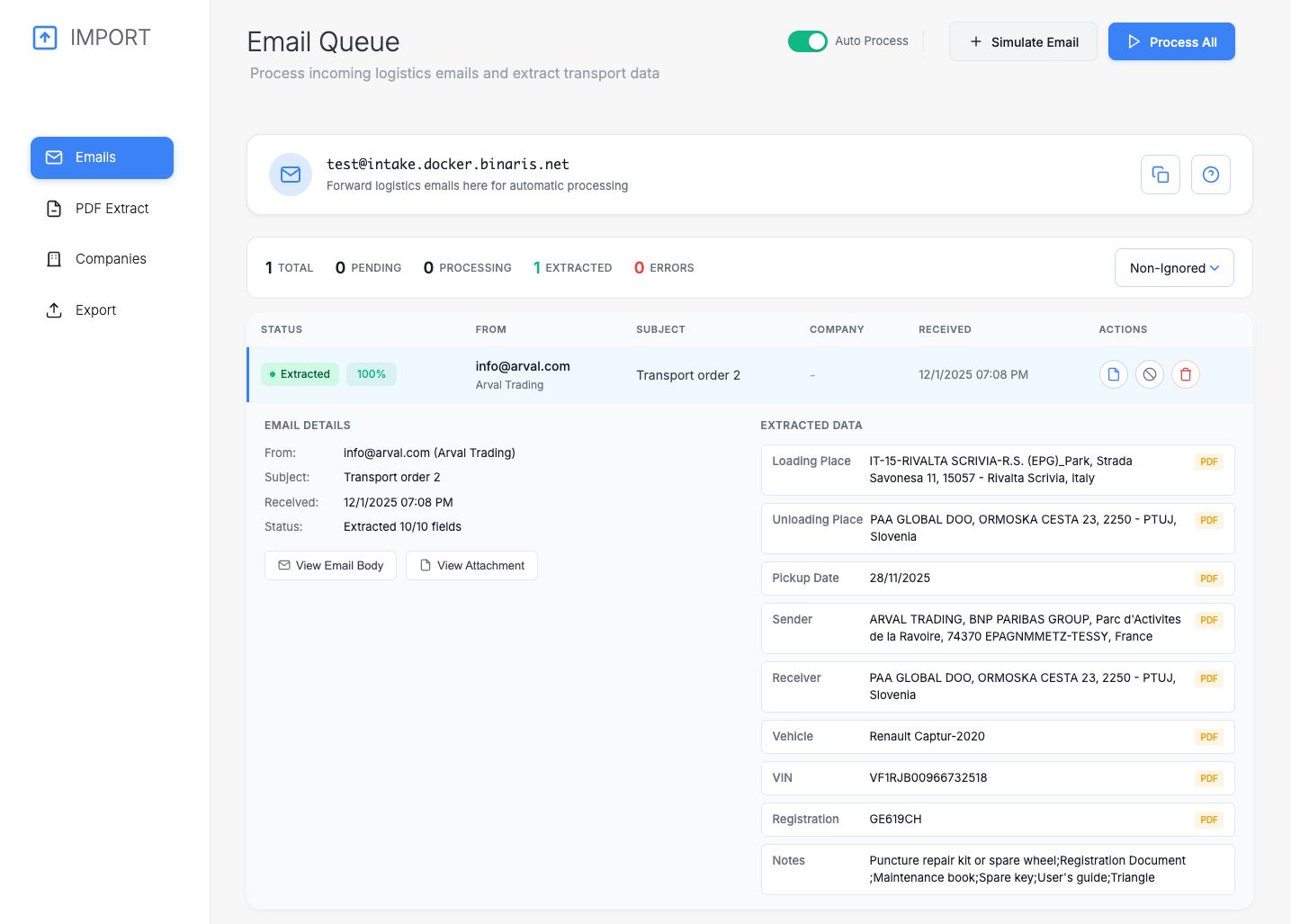
Each extraction includes per-field confidence scores. High-confidence results are automatically exported to Google Sheets. Low-confidence fields are flagged for human review — and every correction feeds back to improve future accuracy.
From Document to Data in Seconds
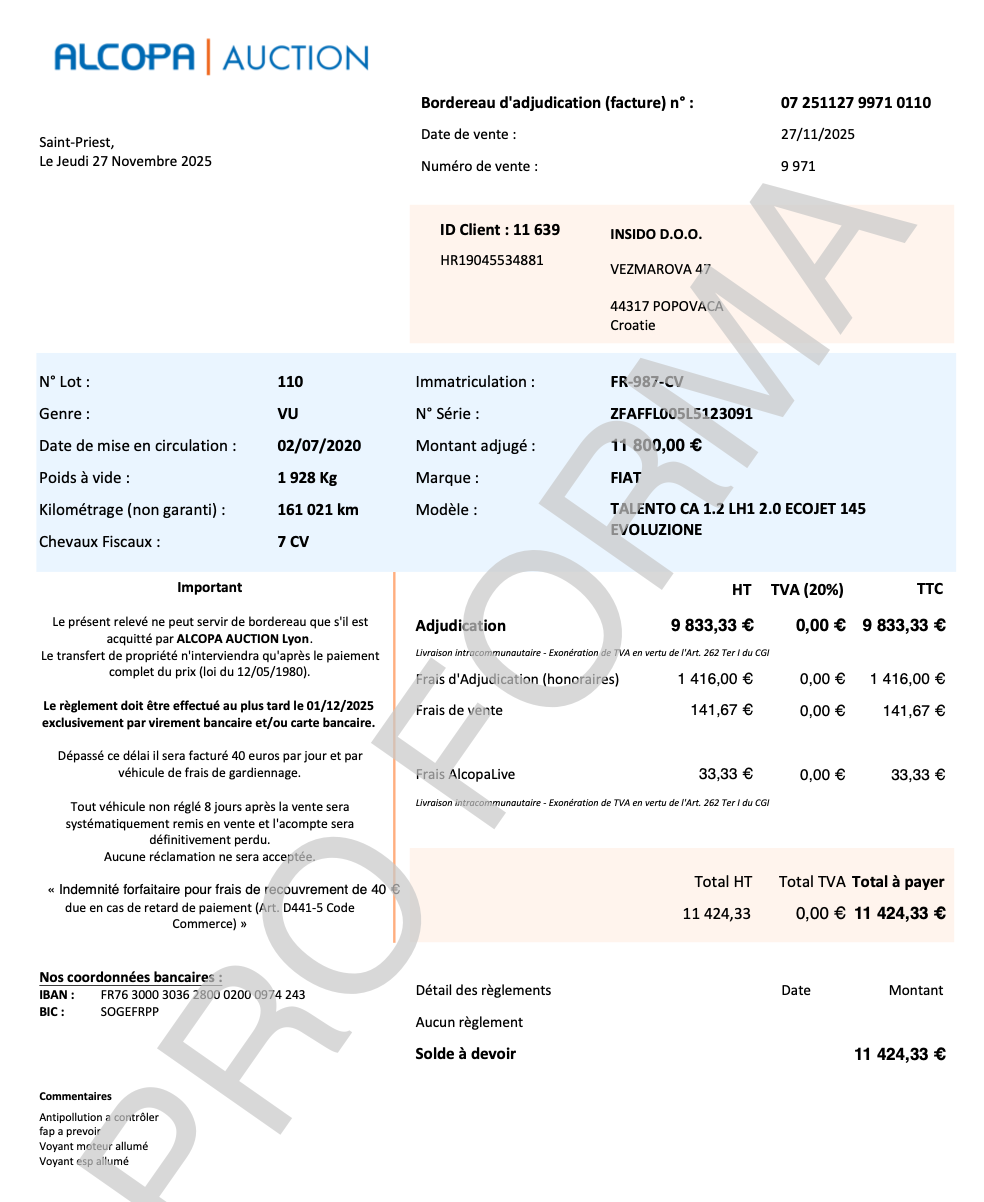
Here's a real example: a French auction invoice arrives as a PDF. The system automatically extracts all relevant transport fields — locations, vehicle details, dates — with per-field confidence scores.

What Gets Extracted
The system automatically identifies and extracts structured logistics data from unstructured documents, regardless of format or language.
The Secret: Few-Shot Learning
Traditional document extraction systems require rigid templates or extensive training datasets. Our approach is different. For each new company format, the user annotates just a few sample documents — highlighting which text maps to which field. The AI then uses these annotations as few-shot examples to process all future documents from that company.
This means onboarding a new partner's document format takes under 5 minutes of human effort. After that, every document from that company is processed automatically with no further intervention needed.
Self-Improving Accuracy
When the system's confidence on an extraction falls below the threshold, the document is flagged for manual review. But here's the key: every manual correction is fed back into the learning system. The patterns are refined, context understanding improves, and the same mistake is not made twice.
The Results
The impact was immediate and measurable from the first week of deployment.
92% Faster Per Document
What took a full minute of focused manual work now happens in 5 seconds, automatically and without human intervention.
Parallel Processing
Unlike manual entry, the system processes all incoming documents simultaneously. No queue, no bottleneck, no waiting.
Up to 17 Hours Saved Monthly
At peak volume of 50 documents per day, the company saves approximately 17 hours of manual data entry work every month. Even at average volumes, that's 7-12 hours reclaimed.
Higher-Value Work
Staff previously tied to manual data entry now focus on customer relationships, route optimization, and business development — tasks that directly grow revenue.
The Platform
The platform provides a clean interface for managing the entire extraction workflow — from monitoring the email queue to reviewing extractions and exporting data.
Have a similar document processing challenge?
Let's discuss how AI-powered extraction can save your team hours of manual work every week.
Book a Consultation